
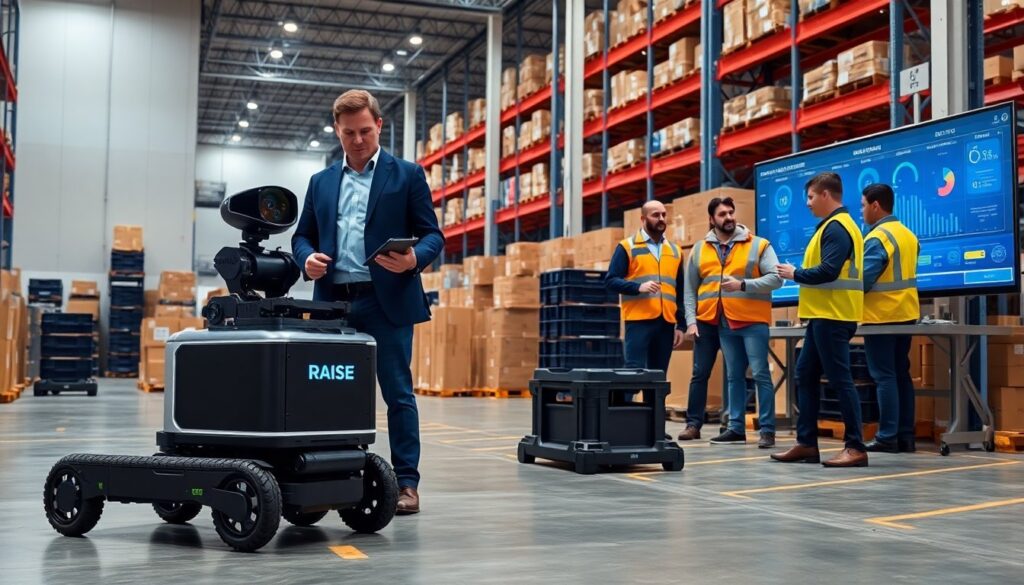
Raise Robotics is a company that builds autonomous robots for warehouses and logistics. It makes robots that move goods, scan inventory, and work with human teams. The technology aims to cut labor time, reduce errors, and increase throughput. This article explains what Raise Robotics does, how its architecture works, common use cases, and how companies measure return on investment.
Key Takeaways
- Raise Robotics delivers autonomous mobile robots and software designed to enhance warehouse and logistics operations by increasing throughput and reducing errors.
- The Raise Robotics system integrates lidar, cameras, and sensors for navigation and obstacle detection, ensuring safe collaboration between robots and human workers.
- Its scalable architecture supports single-robot deployments up to large fleets, managed through cloud software and APIs for seamless system integration.
- Common use cases include order fulfillment, sorting, and replenishment, which help decrease manual travel time, lower picking mistakes, and reduce injury risks by handling heavy loads.
- Deployment begins with site assessment and pilot programs to validate performance improvements and ROI, which often appear faster in high labor cost environments.
- Raise Robotics systems enable businesses to scale labor efficiently, improve order velocity, and adapt quickly to peak demands and complex fulfillment needs.
What Is Raise Robotics And Who Is It For?
Raise Robotics builds mobile robots and software for warehouses and distribution centers. The company sells systems that support picking, sorting, and transport. Its customers include third-party logistics providers, retailers, and manufacturers. The product suits sites that need higher throughput and lower error rates. Small sites can use one robot. Large sites can run a fleet. Teams can integrate Raise Robotics with existing warehouse management systems. The company offers support for pilot programs, training, and hardware servicing.
How Raise Robotics Works: Core Architecture And Workflow
Raise Robotics combines hardware, onboard compute, and cloud software. The system uses maps, schedules, and task queues. Sensors feed data to local processors. The cloud stores fleet status and analytics. Operators dispatch tasks from a dashboard. Robots accept tasks, plan routes, and report progress. The software updates maps and optimizes routes in real time. IT teams connect the Raise Robotics API to their order systems. The stack focuses on reliability, uptime, and simple integration.
Navigation, Perception, And Fleet Coordination
Raise Robotics equips robots with lidar, cameras, and IMU sensors for location. The perception module detects obstacles and people. Navigation plans safe paths and avoids collisions. Fleet coordination assigns tasks to robots based on load and location. The scheduler balances efficiency and battery state. The system pauses or reroutes robots when it detects human activity. Operators receive alerts for faults and blocked paths. The architecture supports mixed human-robot workflows and shift changes.
Top Use Cases And Business Benefits For Warehousing And Logistics
Raise Robotics fits order fulfillment, sortation, and replenishment tasks. The robots reduce manual travel time and speed order cycles. Sites see lower picking errors and steadier throughput during peak hours. The system helps teams scale labor without long hiring cycles. Raise Robotics also cuts injury risk by moving heavy loads. Customers report faster slotting changes and fewer overtime hours. The solution supports same-day shipping and high-mix fulfillment where speed matters.
Deployment, Cost Considerations, And Measuring ROI
Deploying Raise Robotics starts with a site assessment and pilot plan. The pilot validates throughput gains and error reduction. Costs include hardware, software licenses, integration, and maintenance. Sites should model labor savings, uptime gains, and order velocity. Typical payback periods vary by volume and task type. Companies with high labor costs often see faster ROI. Raise Robotics provides baseline metrics and case studies for financial teams to review.