
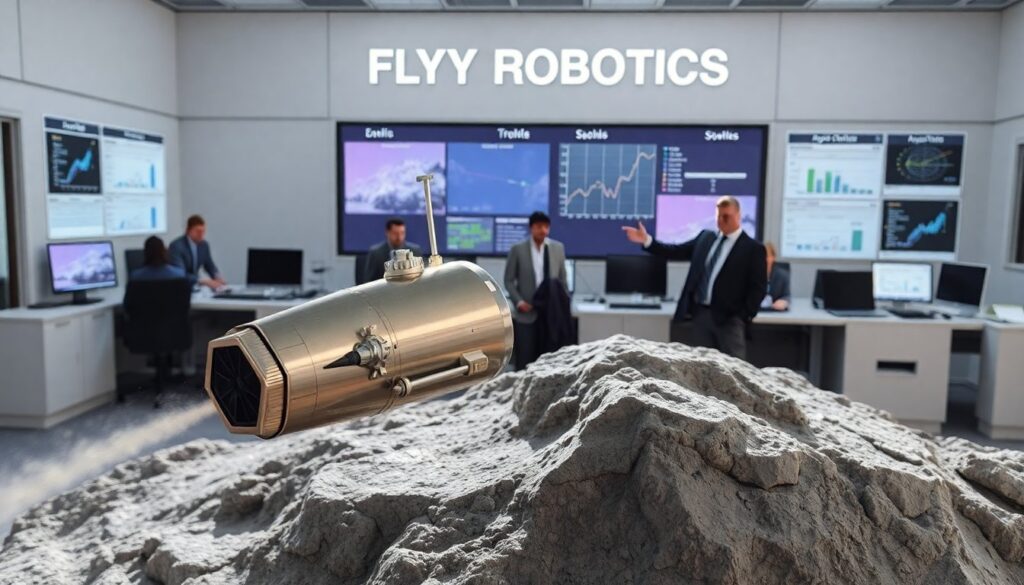
Flyby robotics describe small, fast spacecraft that pass close to a target to collect data. Flyby robotics let teams gather high-resolution images, particle samples, and telemetry without entering orbit. Engineers design these probes for limited time near a target and for quick data relay. Researchers now use flyby robotics to study asteroids, moons, comets, and planetary atmospheres with lower mission cost and risk.
Key Takeaways
- Flyby robotics enable cost-effective, high-resolution data collection by passing close to celestial targets without entering orbit.
- These small spacecraft carry advanced sensors and autonomy systems to capture and transmit key measurements during brief flyby windows.
- Flyby robotics reduce mission complexity and fuel needs by avoiding long-term station keeping and using compact propulsion and guidance technologies.
- Communication innovations like onboard data compression and error correction maximize data return despite deep-space link constraints.
- Future flyby robotics will include swarms and hybrid missions enhanced by AI, enabling faster, more autonomous exploration across the solar system.
- Flyby robotics provide a versatile and rapid-response solution for exploring asteroids, comets, moons, and planetary atmospheres.
What Flyby Robotics Are And How They Work
Flyby robotics refer to unmanned probes that perform close approaches to celestial bodies. The probes fly past a target at planned distances and speeds. They carry sensors, cameras, and sometimes small sampling tools. Mission teams program the probes to collect data during a short window and then transmit that data to an orbiter or ground station. Flyby robotics reduce fuel needs because they avoid capture and long-term station keeping. They also lower mission cost because the probe can have a simpler propulsion and thermal design.
A typical flyby robotics mission begins with target selection and trajectory design. Engineers set a relative velocity and approach vector that maximize data return. On approach, the probe activates high-rate cameras, spectrometers, and particle detectors. It records measurements in solid-state memory and then sends compressed packets after the closest approach. Ground teams plan observation sequences and onboard autonomy handles timing and error recovery. The autonomy lets the probe react if alignment shifts or a sensor saturates.
Flyby robotics use short observation windows to get high-resolution data. They often take advantage of flyby geometry to illuminate targets with the Sun or an orbiter radio beam. Teams use precise timing to capture transient events like outgassing, dust plumes, or rapid shadowing across a crater. Flyby robotics can also deploy sub-systems, such as small impactors or ejectable microprobes, to add context. Mission planners trade time and risk: a faster approach gives wider coverage: a slower pass gives finer detail but needs more delta-v.
Key Technologies Powering Flyby Robots
Flyby robotics rely on compact sensors and efficient communications. High-sensitivity cameras with wide dynamic range capture both bright and dark terrain. Miniature spectrometers analyze surface composition using reflected sunlight or emitted thermal energy. Particle detectors count dust and measure grain speed. These instruments now fit smaller frames because of advances in detector chips and optics.
Onboard processing matters for flyby robotics. The probe must compress images, prioritize packets, and run fault checks within seconds. Low-power, radiation-tolerant processors perform real-time adjustments. Engineers program machine-vision routines that select best frames and flag anomalies. Autonomy reduces ground latency and improves data yield when the link has limited bandwidth.
Propulsion and guidance also shape flyby robotics. Cold-gas thrusters or small electric engines adjust approach and attitude. Star trackers, inertial units, and lidar provide position and pointing data. New guidance algorithms fuse sensor data and predict motion errors. Those algorithms let the probe keep a camera pointed at a moving target even though tumbling or plume activity.
Communications use high-gain antennas and adaptive coding. Probes send compressed data to orbiters or directly to Earth when geometry allows. Delay-tolerant networking protocols handle interruptions and packet loss. Teams use error-correcting codes and incremental redundancy to recover critical frames without full retransmission. Power systems balance battery capacity and solar harvesting. Flight software manages power so instruments run only when they will return valuable data.
Primary Use Cases, Operational Challenges, And Future Directions
Flyby robotics serve several key use cases. They map surface features at fine scale across large regions. They probe tenuous atmospheres and exospheres during short crossings. They sample dust and gas near comets and active asteroids. They scout landing zones for future missions and monitor transient events like eruptions or impacts. Agencies use flyby robotics for rapid response when a new target of interest appears.
Operational teams face challenges with timing and data volume. The probe has a short window to gather high-value measurements. Teams must plan sequences that avoid saturating detectors and that prioritize critical frames. They also must ensure robust autonomy because ground teams cannot react fast enough during the pass. Thermal and radiation exposure pose risks when the probe passes close to a sunlit surface or through a dusty plume.
Another challenge lies in communication constraints. Deep-space links have limited bandwidth and long round-trip times. Engineers use onboard processing to reduce data to essentials and to attach metadata that helps scientists decode measurements. Mission designers add relay orbiters when targets lie far from Earth. Those orbiters buffer packets and send them when the link quality improves.
Future directions will expand the role of flyby robotics. Teams plan coordinated swarms of microprobes that sample a target from multiple angles. They plan hybrid missions that combine brief flybys with brief touch-and-go sampling. Advances in low-mass sensors and AI will let flyby robotics make more autonomous science decisions. Lower launch costs and ride-share options will make more flyby robotics missions affordable.
Flyby robotics will help science teams test hypotheses faster and at lower cost. They will let researchers collect focused data from many targets across the solar system. As sensors shrink and autonomy improves, flyby robotics will play a larger role in routine exploration and in rapid response to new discoveries.